



What’s this new ute all about then?
Jac New Zealand launched the T9 ute in diesel form back in January 2025. It's now been joined by the T9 plug-in hybrid electric vehicle (PHEV). The electrified model was previewed as a prototype at Fieldays last year, and the final production version was launched at the same event this month, on June 10-13.
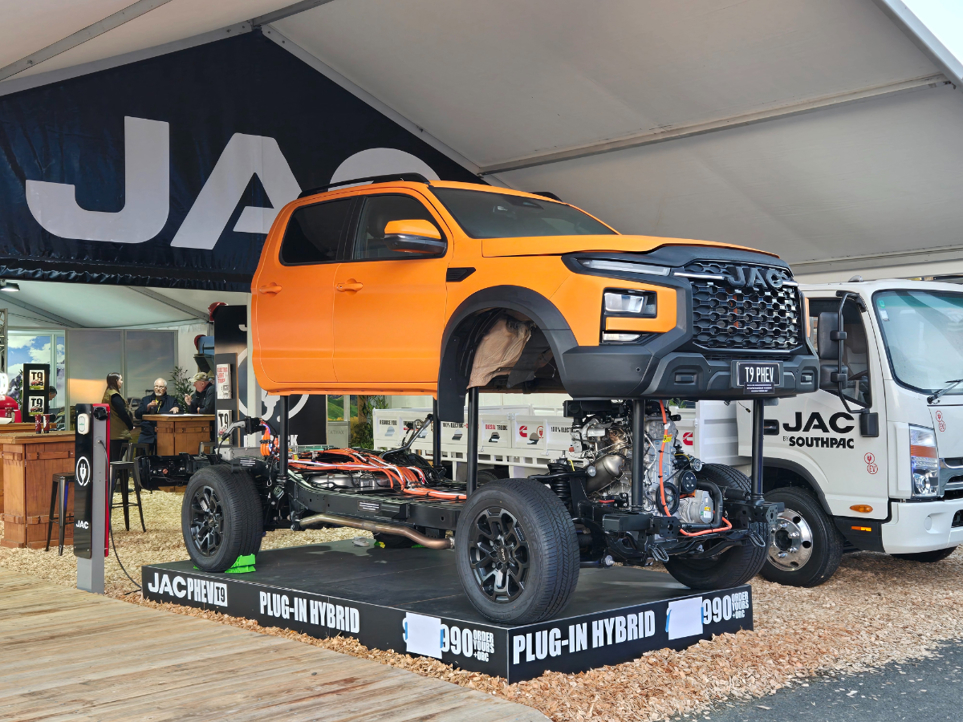
The orange prototype is also back on show as it happens, although the body has parted company with the chassis to show the complicated inner workings of the electric drive. "It's had a little facelift," says Jac NZ general manager Andrew Craw.
Speaking of the complicated bits: the T9 PHEV matches a 2.0-litre turbo-petrol engine with two electric motors, driving through a dedicated hybrid transmsision (DHT) - which makes it more of a "super hybrid" type of powertrain than a conventional PHEV.
Joining the petrol engine up front is a "P2.5" electric motor in the middle and a "P4" on the rear axle; there's no physical connection between the rear motor and the rest of the powertrain. The plug-in battery is 30kWh and can be DC fast-charged.
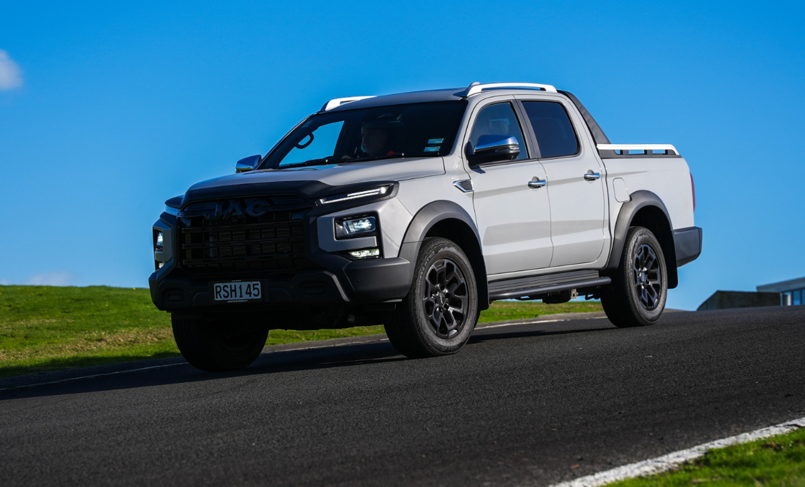
Total system output is 360kW/674Nm. If you added the individual power sources together you'd have 435kW/1010Nm, but that's not how these things work when they're all integrated. The new ute can hit 100km/h in 6 seconds.
Jac claims 100km EV range from a full charge, but that's an NEDC figure via Australia rather than the Kiwi-standard WLTP. The localised numbers will come, but the local team says it drove 85km on the Napier-Taupo Highway in EV mode, and achieved 2.6l/100km on a drive from Auckland to Whangarei, which includes some pretty big climbs.
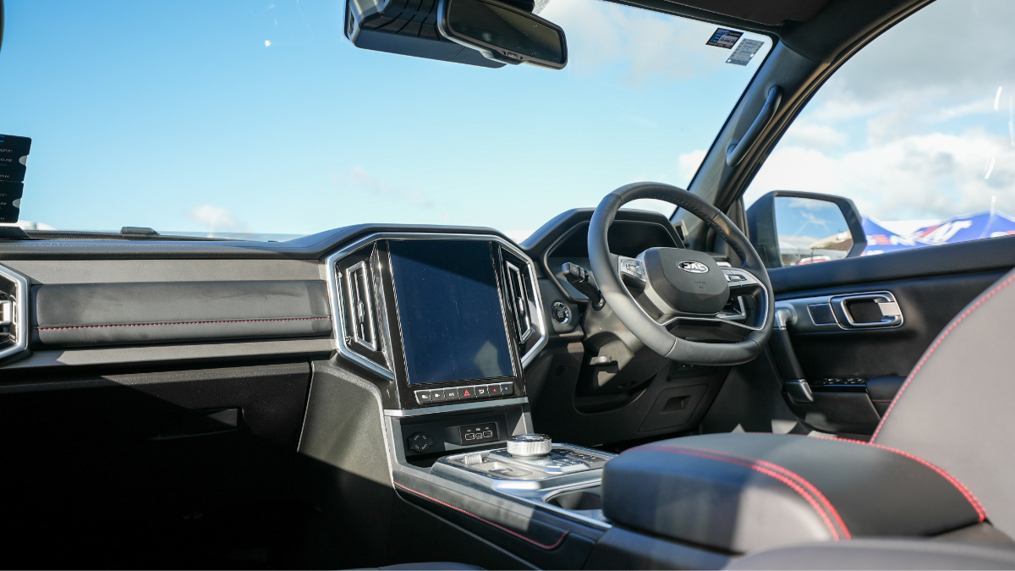
The T9 PHEV also offers 3.3kW vehicle-to-load (V2L) functionality.
Thanks to the DHT, the powertrain can work in different ways. The T9 PHEV can be a RWD EV (suitable for urban driving), a RWD series-hybrid with the petrol engine running as a generator to charge the battery (if the battery is running low, or at open road speeds), a FWD parallel-hybrid with the petrol engine driving the wheels, assisted by the centre e-motor (highway driving, long trips) or a full AWD with the petrol and centre motor driving the front axle, and the rear e-motor driving the rear axle independently (towing, off-road, low traction surfaces).
There are front, centre and rear differential locks, dedicated off-road and crawl drive modes, and off-road quick-access buttons.
How much is it?
The T9 PHEV has been introduced at a special launch price of $59,990. Just how special we don't know, because the brand has not shared the full retail figure; nor has it confirmed when the offer will end.
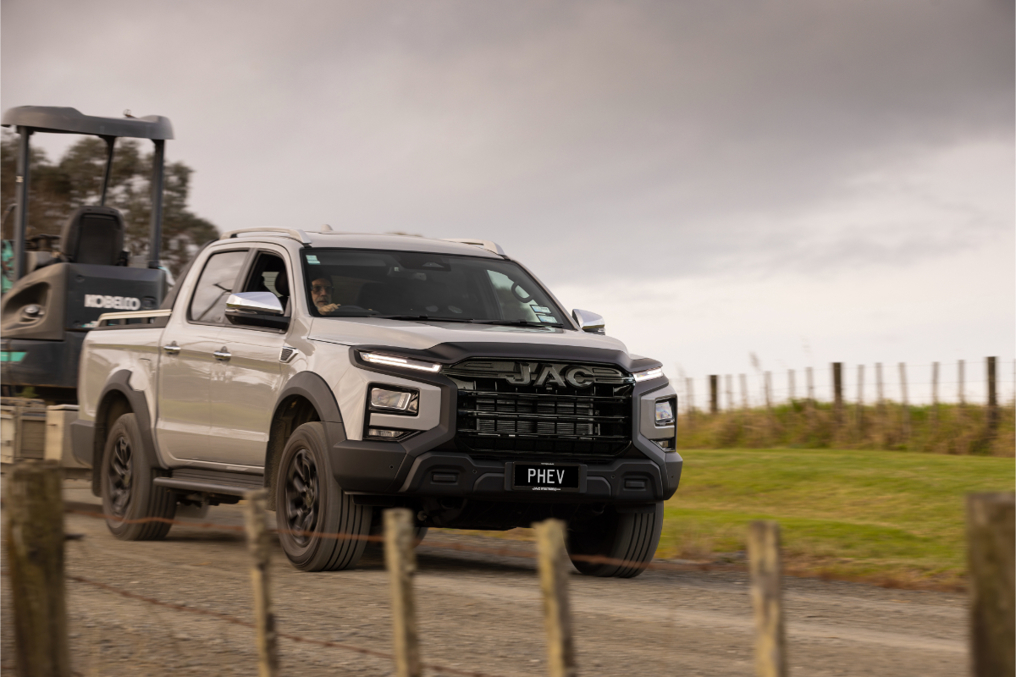
The standard T9 diesel is $49,990, or $52,980 for the Black Out Edition.
Craw says Jac NZ has 100 PHEVs ready to hit the production line, with deliveries late-July or early-August: "If we need more, we'll order more. But we think that's a good number to start with, and we'll see how we go from there."
With that price and a 5-star ANCAP rating (the PHEV was tested specifically), Craw claims the T9 is the "cheapest AWD PHEV [ute] on the market, the safest, and the most powerful".
What’s it like to drive?
Full disclosure: our first experience of the T9 PHEV was at Fieldays, the drive limited to a go-kart track just off-site. That's as much as we'll get for now, because Jac NZ only has two vehicles in the country, and neither are quite final-specification.
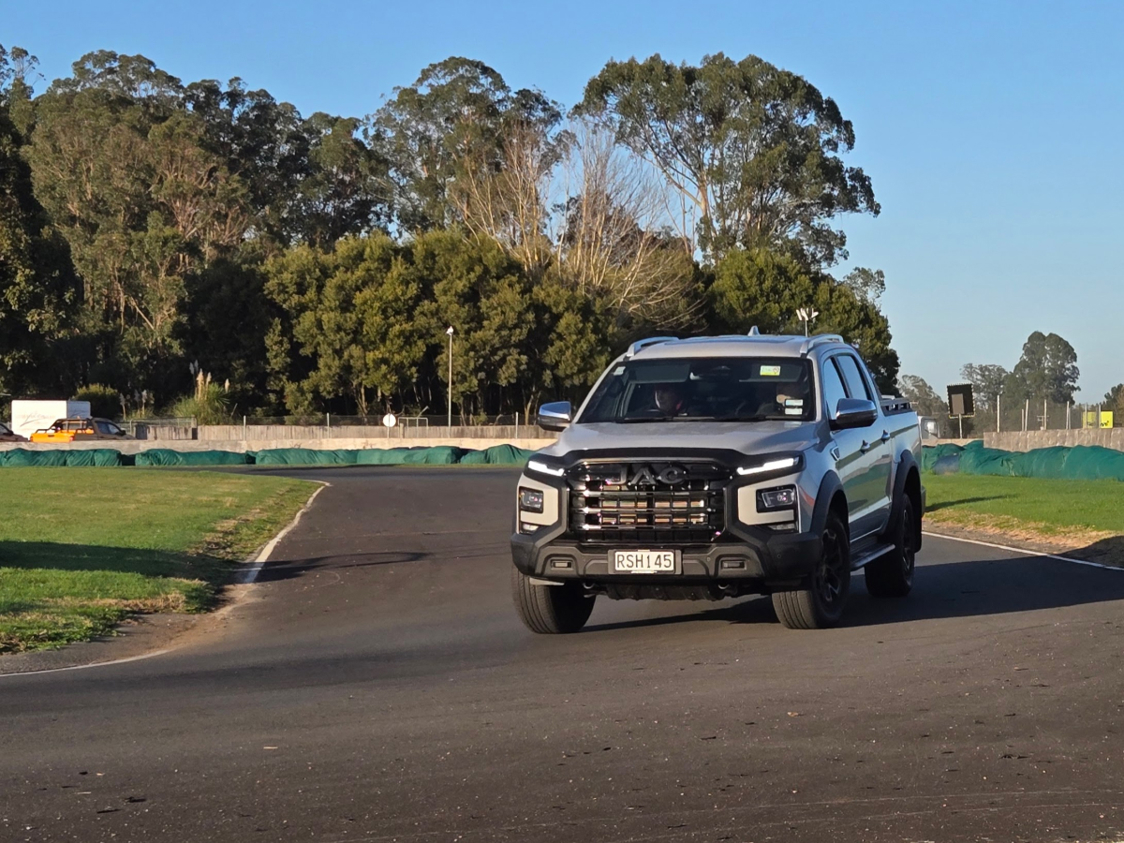
The T9 PHEV has undergone some tuning in Australia, and apparently the final touches are still being applied to the rear suspension before the factory starts building Australasian-market cars. So no point doing too much with it until the first shipment lands.
However, a quick spin showed the PHEV to be a solid-feeling ute, with decent steering and a perky powertrain; even in RWD-EV, because you've still got 150kW/340Nm in play.
What’s the pick of the range?
There's just the one T9 PHEV for NZ, unlike Australia where there's likely to be four different variants.
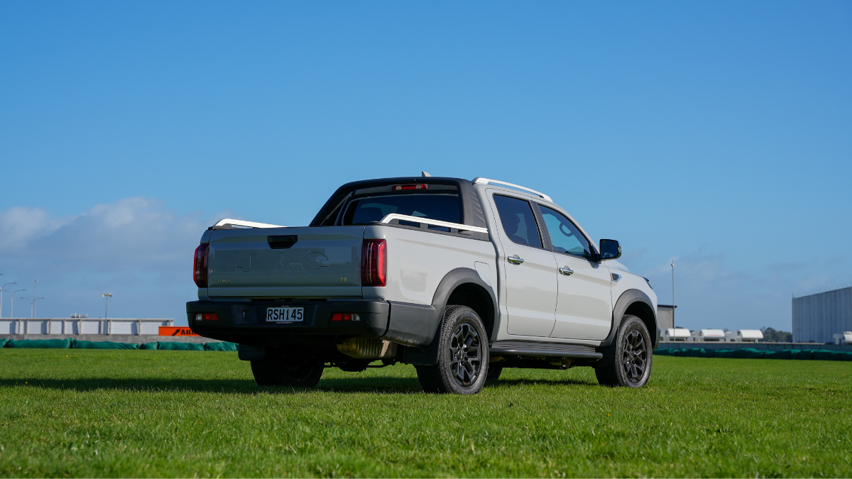
The T9 PHEV is a very similar specification to the T9 diesel Black Out Edition, with dark detailing on the outside and the full equipment list inside, including leather upholstery. It's missing the sunroof, but gains wireless Apple CarPlay, reach-adjustment for the steering wheel and a soft-close tailgate.
"We wanted a similar strategy to the T9 diesel," says Craw. "One model, just to keep it easy. The market's small".
Simplicity is also the reason Craw isn't too worried about not being able to use the Hunter name originally mooted for the PHEV in NZ [it's already spoken for with another company]: "We spoke to the Chinese about it and it's not a name they use. The South Africans use it on the diesel. It just got too confusing.
"We've got one model, so let's keep it simple. We've got a T9 diesel, we've got a T9 PHEV."
What other utes should I consider?
It's natural to look to the two other Chinese PHEV-utes in this segment. The $69,990 BYD Shark 6 wellside is the big player, with a super hybrid powertrain. It's not as focused on 4x4 work as the Jac and the entry model is limited to 2.5 tonne towing; you have to step up to the new $76,990 Performance to get the full 3.5t.
The GWM Cannon Alpha is half a size up on the T9 and a more conventional plug-in hybrid, but also optimised for hard-core off-roading. It's priced at $60,990-$69,990.
Probably the closest thing in concept to the Jac is the Ford Ranger PHEV, which also aims to combine plug-in power with no compromise to 4x4 and tow-ability. It costs, though: $82,990-$89,990.
Or you could go full-electric, with the $69,990 Riddara RD6 Pro (3t towing) or $79,990-$85,990 Toyota Hilux BEV (2t).
Or check out our guide to NZ's electrified utes here.