



The Foton Tunland has been part of the New Zealand ute landscape for longer than its current profile might suggest. The original Tunland arrived here in 2014, imported by BYD, Ram and Jeep distributor Ateco Automotive, at a time when Chinese automotive brands were still very much outsiders in the local market. It was a relatively simple, affordable double-cab ute, and while it never came close to troubling the established players for sales, it established Foton as a name in the local commercial-vehicle market.
Foton's New Zealand representation subsequently moved to Hamilton-based Ebbett Group, and the first-generation Tunland eventually disappeared from the market, but Foton itself didn't go away. Instead, its focus remained on commercial vehicles, with the company building a more substantial local operation from its base in Hamilton.
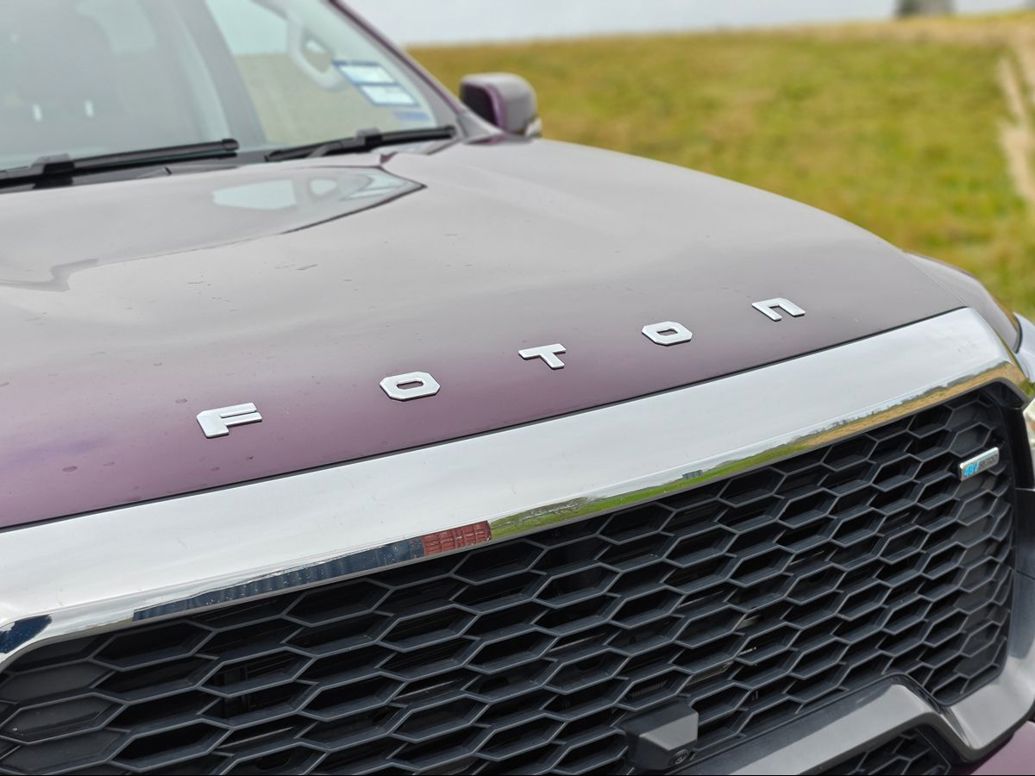
While the original Tunland was a relatively niche proposition, Foton was already looking towards something considerably more ambitious, but that next-generation ute has taken its time getting here.
Foton sent an engineering team to New Zealand back in 2018 to study the local market and, more importantly, understand what Kiwi ute buyers actually expected from a modern workhorse. The result is the Tunland V-Series, a much larger and more sophisticated ute that finally brings Foton's latest-generation product to New Zealand.
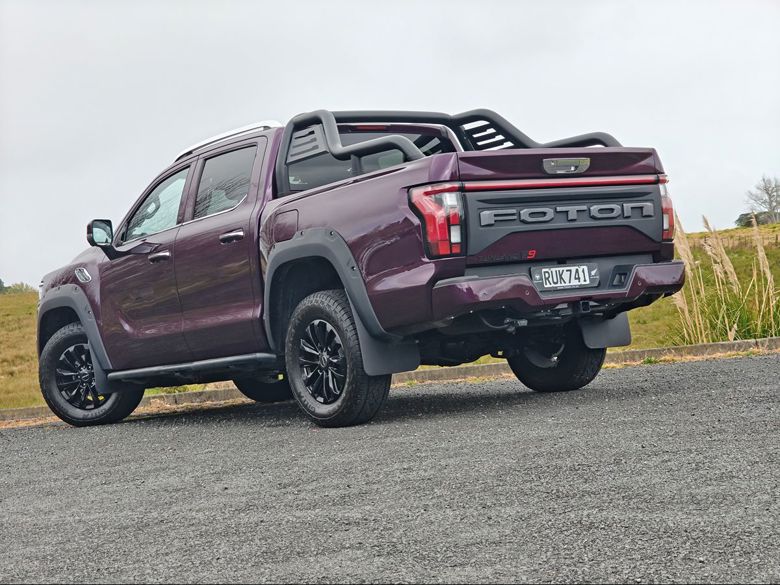
The V-Series is represented here by the V7 and V9, and the difference between them and the original Tunland is substantial.
Both are powered by a 2.0-litre turbo-diesel with 48-volt mild-hybrid assistance and an 8-speed automatic transmission, producing 120kW and 450Nm, with the V7 being the more overtly work-focused of the pair, retaining a leaf-sprung rear suspension and offering the sort of practicality expected of a conventional one-tonne ute, while also being available in 4X2 or 4X4 forms.
The V9, on the other hand, pushes further towards the lifestyle end of the market, only being available in 4X4 with multi-link coil-spring rear suspension and a more SUV-like specification.
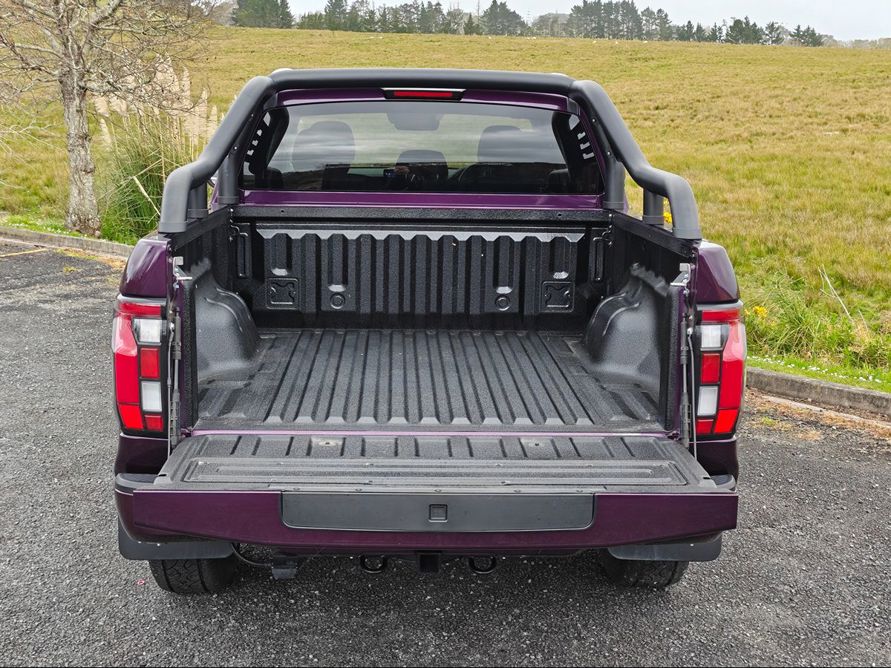
And both are big. Like, very big - exceeding the dimensions of the larger crop of one tonne utes we have seen from the likes of BYD, GWM and MG, and approaching the big American full-size pick ups like the Ram 1500 and Ford F150.
While not quite as large - the Tunland is roughly as wide and as tall as a Ram 1500, but is around 200mm shorter, with an equally truncated wheelbase - the two Tunland variants also happen to look rather a lot like those two big Americans as well. Something that is entirely coincidental, we are sure...
In a practical sense, the V9 is very much up there with the competition in terms of sheer working ability - 3500kg towing on a braked trailer and an impressive 995kg payload for the rear tray (the leaf-sprung V7 exceeds a full tonne) handle the hauling, while 240mm of ground clearance and a 700mm wading depth keep it capable off the road, although its approach, breakover and departure angles of 28 degrees, 21 degrees and 26 degrees are acceptable rather than exemplary.
On the outside: what are the Foton Tunland V9's main design features?
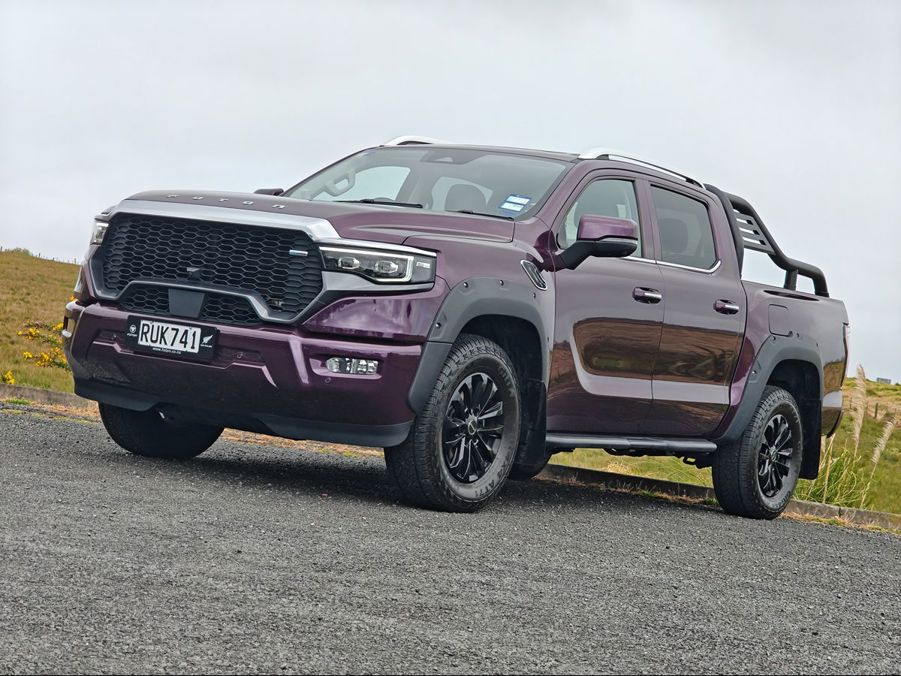
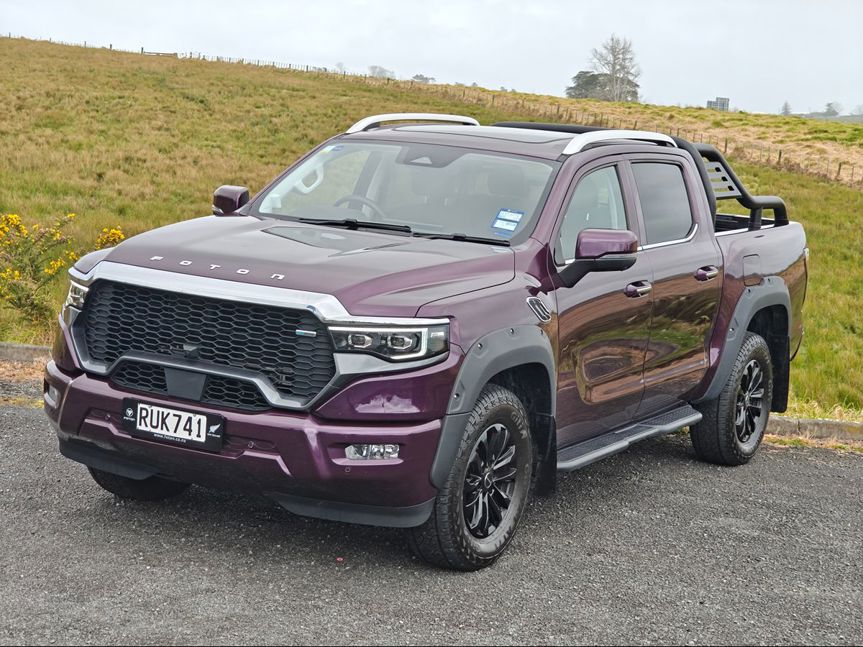
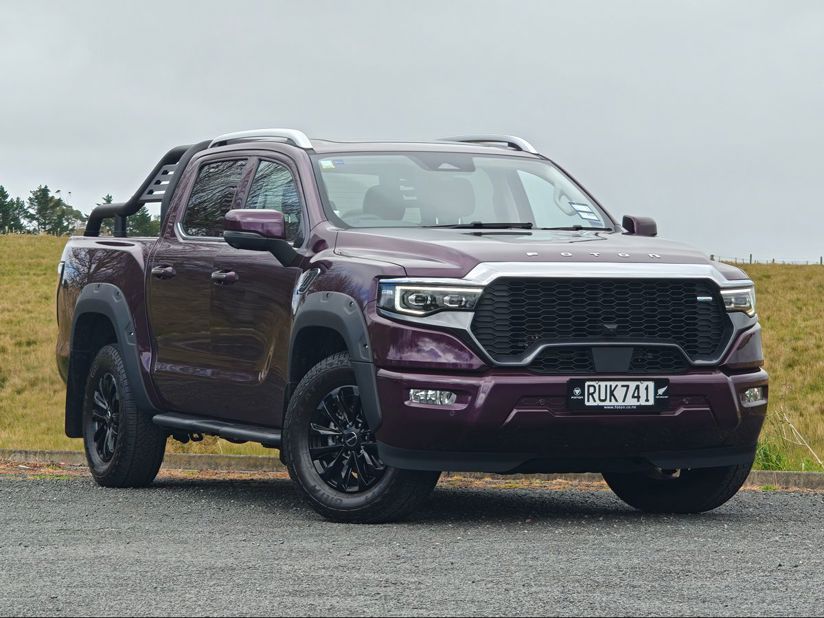
As mentioned, the current Tunland V range is unapologetically styled in the image of a modern American full-size pickup and, as a result, are big, handsome things.
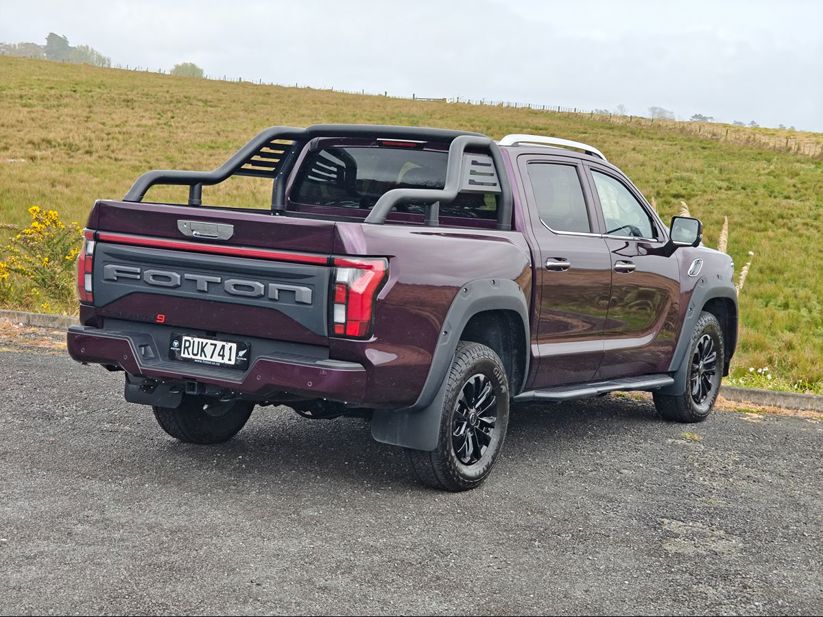
Our test vehicle leaned hard into boldness, particularly with its metallic purple paint job that both looks brilliant and suits its extrovert persona.
Where the more work-oriented leaf-sprung V7 wraps its big, blunt nose with a Ford F150-style visage, the more lifestyle-y V9 heads much in the Ram 1500’s direction, and from most angles that resemblance is the point.
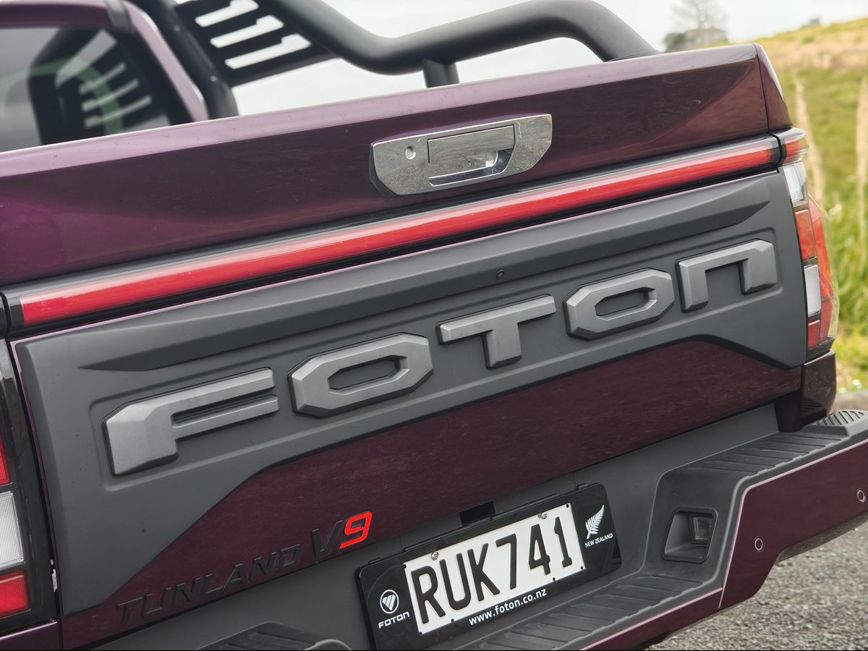
The proportions are generally good, but you do notice a wide body riding on a comparatively narrow track. That leaves the wheels sitting well inside the arches, which can make it look a touch under-wheeled and slightly awkward in certain stances.
The V9 suffers from this the most, as it packs black wheel arch extensions that the V7 avoids, giving it an even narrower look to its track. However, the overall effect still reads tough and imposing, helped by that big, bluff front-end that majors on blocky confidence and a lot of visual muscle.
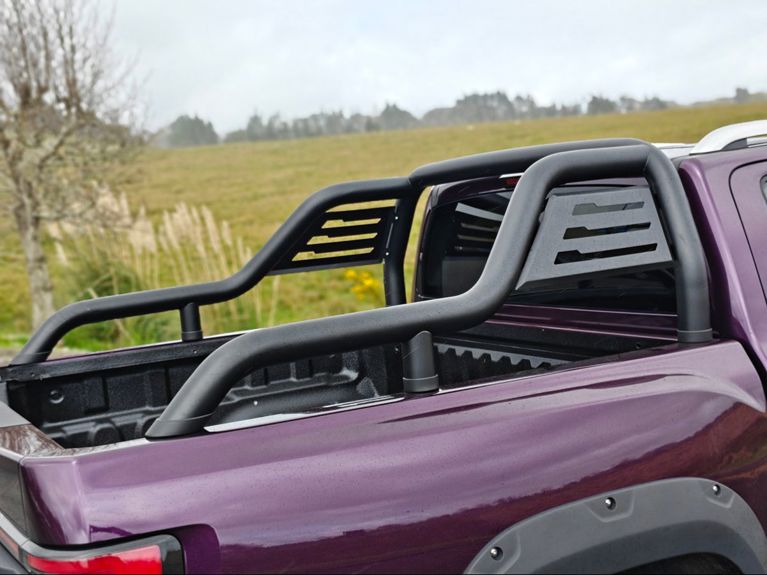
There are plenty of other add-ons that the V9 gets over the V7, including some roof rails and a very elaborate sports bar that stretches the entire length of the tray. Whether you love the extra jewellery or prefer the V7’s cleaner look will be down to taste, but our test vehicle leaned hard into boldness, particularly with its metallic purple paint job that both looks brilliant and suits its extrovert persona.
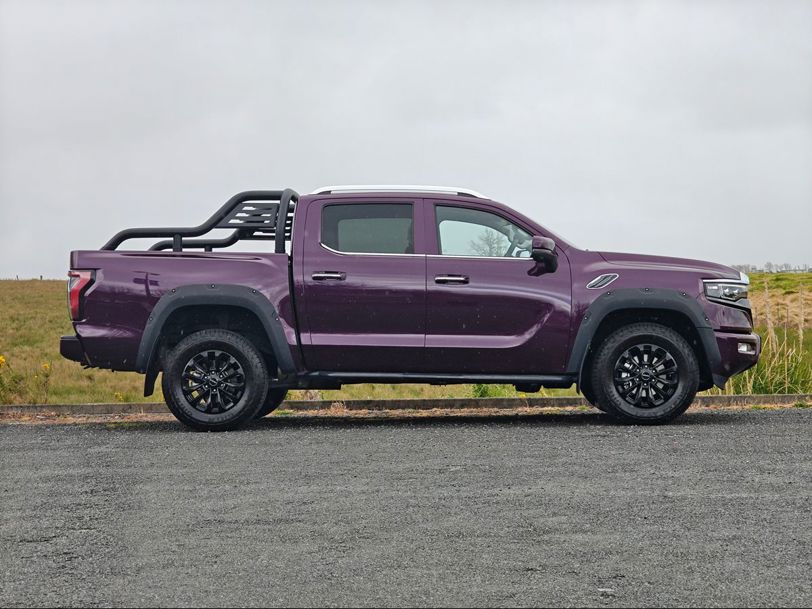
The net result of all this, however, is that the V9 largely nails the “big American truck” look, even if a few details give away its origins.
OVERVIEW
| Price | $57,990 |
| Body style | Double cab ute |
| Wheels and tyres | 18 inch alloy wheels, 265/70 tyres |
| Length | 5617mm |
| Wheelbase | 3355mm |
| Weight | 2315kg |
| Website | foton.co.nz |
On the inside: what's the Foton Tunland V9's cabin like?
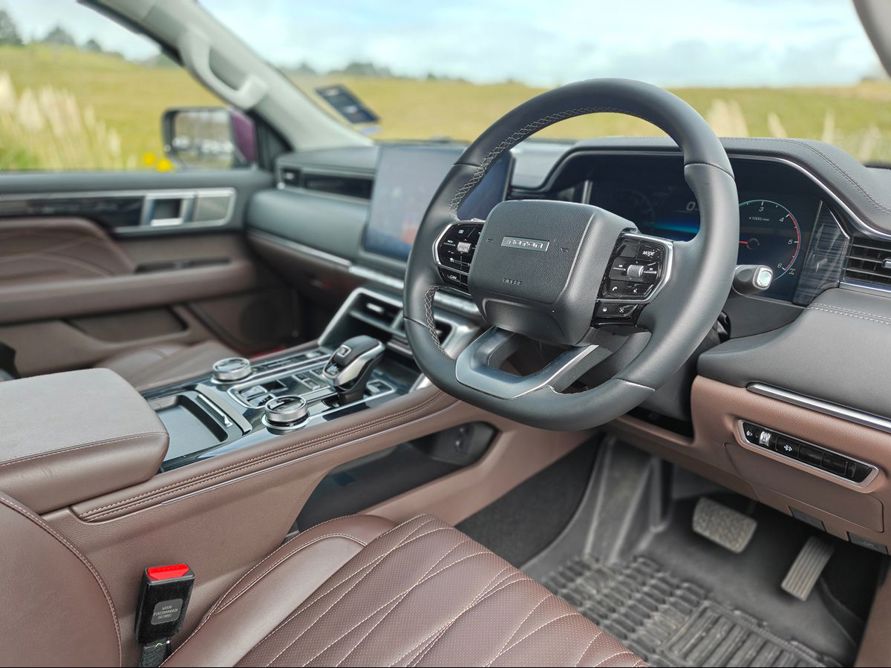
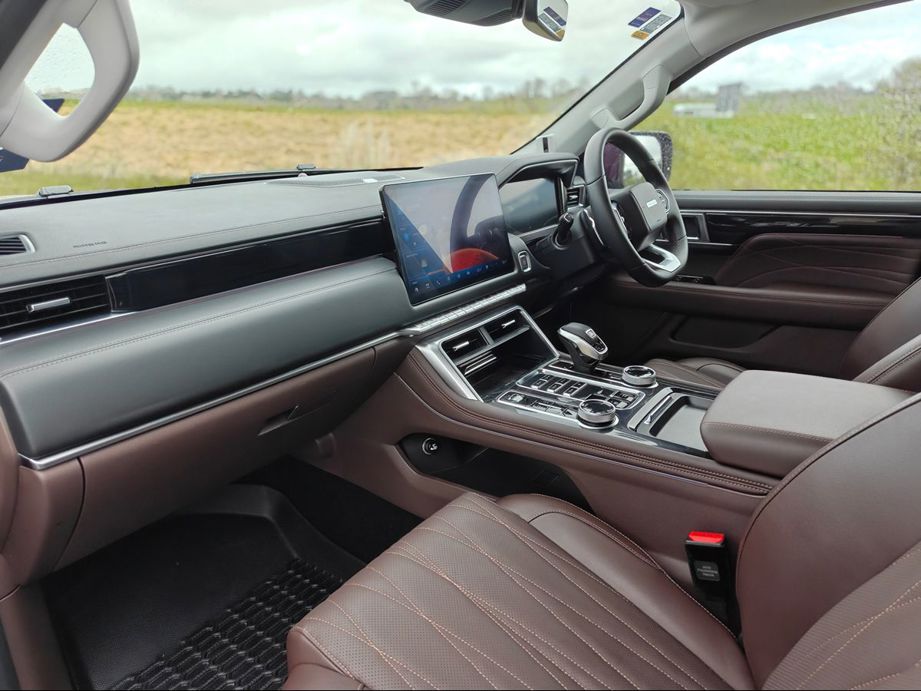
Inside, the American theme continues. You get dark chocolate-brown upholstery with orange stitching, glossy wood trim, and stitched surfaces that do a convincing job of feeling premium, even if the leather may not be the genuine article.
Despite the big American look, the V9 drives like a well-sorted four-cylinder diesel one-tonne Chinese pickup.
The seats are broad and comfortable but notably flat, and their backrests never seem to come quite far enough forward, and you end up driving with a slight lean, which feels odd and may frustrate taller drivers looking for a more upright posture.
Climate control is the cabin’s chief misstep: it tends to deliver either warm air or icy cold with little finesse in between, making it tricky to find a pleasant middle ground, while the audio system is average, and the omission of Android Auto is a standard Chinese-market annoyance. Apple CarPlay is present, however, but Android users will rightly raise an eyebrow.
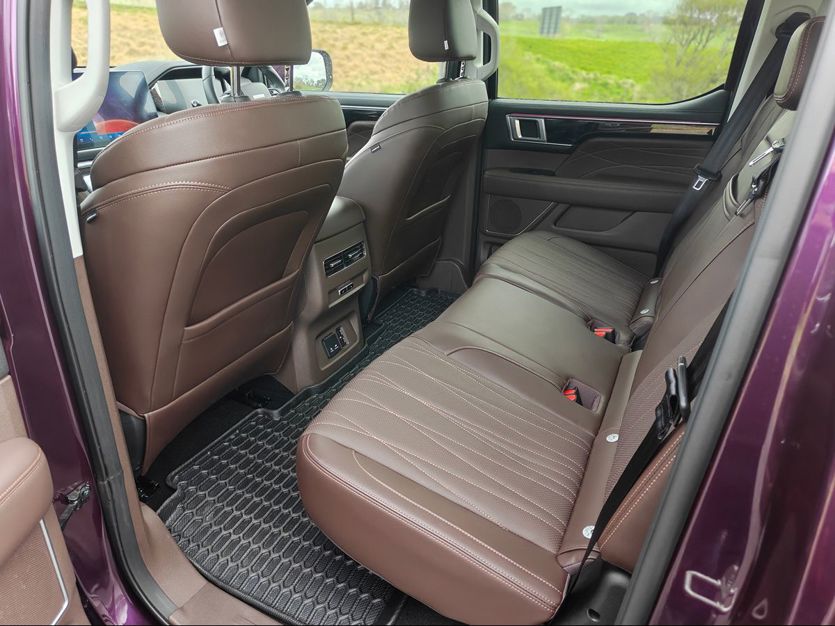
As you might expect from an absolutely enormous ute, interior space is a highlight and the V9 boasts an absolutely huge amount of cabin real estate, with generous room front and rear, and plenty of storage for work gear or weekend clutter.
INTERIOR
| Head-up display | No |
| Infotainment screen | 14.6 inches |
| Phone projection | Wireless Apple CarPlay |
| Wireless phone charger | One |
| USB ports | 2x USB-a front, 2x USB-A rear |
| Climate control | Dual zone |
| Front seat heating/ventilation | Yes/Yes |
| Front seat adjustment | Power, 6-way driver, 4-way passenger |
| Rear seat split/fold | 60/40 |
| Power tailgate | No |
On the road: what's the Foton Tunland V9 like to drive?
Despite the big American look, the V9 drives like a well-sorted four-cylinder diesel one-tonne Chinese pickup.
The ride is traditional ladder-frame fare: capable and perfectly acceptable, but nowhere near plush or luxurious. It’s comfortable enough for long days but doesn’t deliver the more compliant waft you might associate with full-size American trucks.
The engine is willing and solid, providing honest performance that suits everyday ute duties, but you won’t find the muscular V8 or burly six-cylinder soundtrack of a Ram, and it’s definitely a four-cylinder diesel under the bonnet, albeit one that is complimented by a 48-volt mild hybrid system that nicely fills in the gaps where turbo lag would usually lurk.
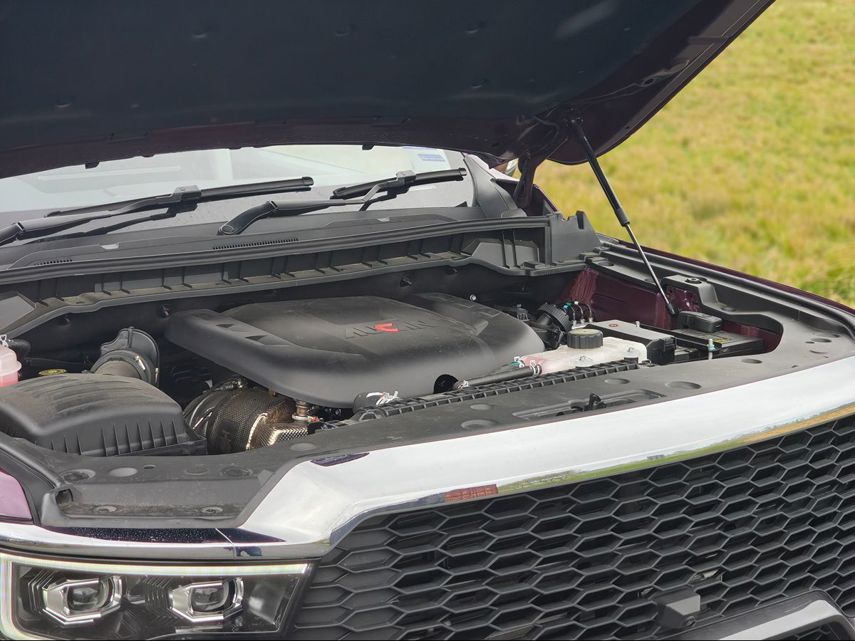
However, with just 120kW, it’s certainly not powerful, although it leans nicely on its considerably more healthy 450Nm of torque when up and running, making it a capable, straightforward worker rather than a performance hero.
The Tunland V9 is an honest, capable drive that matches the one-tonne class norm without pushing boundaries.
Handling is similarly on the level: competent, predictable, and free of nasty surprises. But there aren’t many pleasant ones either, and it does its job without flair. The transmission, however, is a standout, being smooth and quick to respond, which helps the V9 feel more polished around town and on the open road.
Driver assistance systems are a mixed bag. The good news is you can turn the more intrusive features off and they stay off, and their alerts are quiet enough not to grate with the stereo on.
Less good is the “intelligent” cruise control, which slows dramatically at the mere hint of a curve, and lane centring that ping-pongs between markings and has you wrestling with it - best to disable that and keep basic lane assist on if you must.
Much like its similarly large Chinese siblings like the MG U9, the V9’s sheer size is actually its worst enemy when it comes to the assists, as a white line is never all that far away from its huge frame.
Overall though, the Tunland V9 is an honest, capable drive that matches the one-tonne class norm without pushing boundaries.
SPECIFICATIONS
| Powertrain type | Four-cylinder diesel mild hybrid |
| Capacity | 1968cc |
| Power | 120kW |
| Torque | 450Nm |
| Transmission | 8-speed, 4WD |
| Power to weight | 51.8kW/tonne |
| Adaptive suspension | No |
| Efficiency | 8.1l/100km (manufacturer claim) |
| Tank size and fuel type | 76 litres, diesel |
| Tow rating | 3.5 tonnes |
On ownership: what's the Foton Tunland V9's warranty and servicing situation?
Foton offers a 7 year/unlimited kilometre warranty on the Tunland, along with 7 years of roadside assist. Service intervals are set at 12 months or 15,000km.
On the whole: what do we think of the Foton Tunland V9?
It’s easy to be initially underwhelmed if you judge the Tunand V9 purely on driving dynamics or luxury polish - it does everything well enough, but nothing spectacularly. It keeps up with the pack, but falls short of the leaders - and then you get to the price.
If you want full-size truck swagger on a one-tonne budget, the Foton Tunland makes a very strong value case. And looks really cool doing it.
That’s where the Tunland range becomes compelling. The V9 serves up the looks, presence, and sheer size and presence of a big American pickup for less money than a basic mainstream one-tonne ute, and it’s stacked with equipment.
You accept compromises, but they’re the sort that keep it within the class standard rather than lagging behind it. The cabin is huge, the tray is generous, and while exact tow and payload figures should be confirmed, a 3.5-tonne towing expectation puts it squarely in the practical camp.
So, is it an advance on the segment? No. Is it up to the segment’s accepted standard while offering a lot more size and gear for the money? Yes - and that’s the heart of its appeal.
If you want full-size truck swagger on a one-tonne budget, the Foton Tunland makes a very strong value case. And looks really cool doing it.
Foton Tunland V9 FAQs
What kind of car is the Foton Tunland V9?
A large double cab ute.
Does the Foton Tunland V9 have hybrid or EV technology?
Yes, the Tunland has a 48-volt mild hybrid assist system on its 2.0-litre four-cylinder turbo diesel engine.
What’s the fuel economy of the Foton Tunland V9?
Foton claims a combined fuel consumption of 8.1l/100km for the Tunland V9, although this is an Australian ADR figure that uses the NEDC test cycle. RightCar lists the V9's consumption at 9.3l/100km.
Is the Foton Tunland V9 safe?
The Tunland V9 has not been tested by ANCAP. It has a total of 8 airbags, including dual front, side and curtain airbags, a driver's knee airbag and a centre front airbag.
What safety and assistance features does the Foton Tunland V9 have?
| Intelligent lights | Automatic LED |
| Rain sensing wipers | Yes |
| Airbags | 8 |
| Adaptive cruise control | Yes |
| Driver attention monitor | Yes |
| Traffic sign recognition | Yes |
| Forward collision warning | Yes |
| Blind spot warning/assist | Yes/No |
| Lane departure warning/assist | Yes/Yes |
| Rear cross traffic alert/braking | Yes/No |
| Reverse collision braking | No |
| Parking sensors | 4x front, 4x rear |
| Camera system | 360 degree |
What are the Foton Tunland V9's main rivals?
- GWM Cannon Alpha diesel ($57,990): Slightly smaller in every dimension but still huge. Similar spec.
- MG U9 Explore ($60,990): Again, slightly smaller, but with a stronger engine. Still plenty of presence.
- BYD Shark 6 Premium ($71,990): Not as big, but considerably more powerful. Much pricier though.
- Ford Ranger XL ($59,990): Billy basic XL with a 2.0 is the closest 4x4 you'll get to Foton prices in Ranger.
- Ram 1500 Express ($124,990): Sure, it's more than double the power, but its more than double the price too. Looks pretty similar though...


