


For generations of Kiwi enthusiasts, the Chevrolet small-block V8 has been the soundtrack to Holden and HSV performance. From the VT Commodore SS to the supercharged GTSR, these big-capacity V8s helped define an era of Australian muscle, and became just as familiar on New Zealand roads.
That era officially ended on October 20, 2017, when the last Australian-built Holden, a Commodore SS-V Redline powered by the Gen IV LS3, rolled off the Adelaide production line. But while the Commodore was gone, the V8 itself was far from finished.
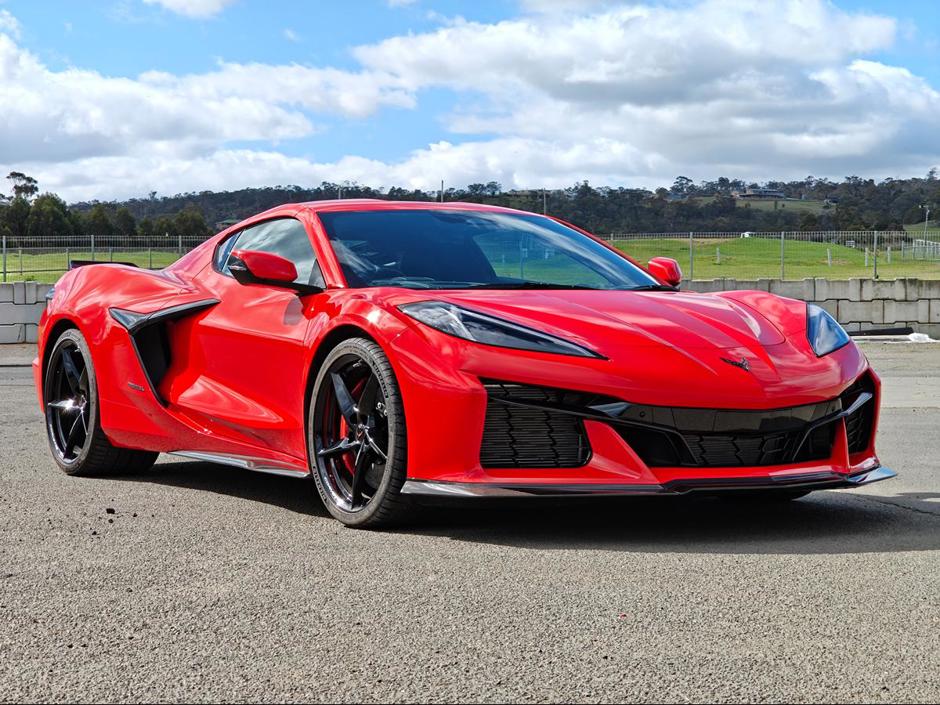
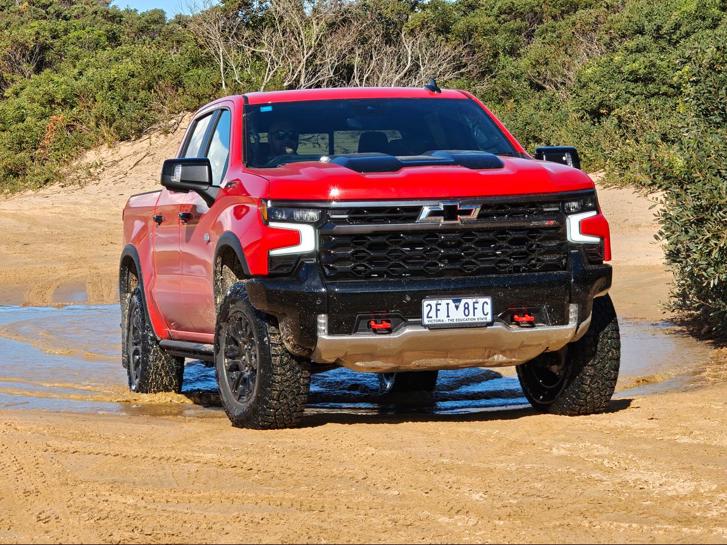
Today, that same small-block DNA lives on in two unlikely stablemates: the mid-engined C8 Corvette Stingray and the full-size Silverado ZR2. One is built to chase lap times, the other to charge across sand dunes, yet both owe a considerable debt to the engines that powered our favourite Holdens.
Plus there's a missing link in that story: HSV's right-hand-drive Chevrolet Camaro.
From Holden and HSV to the modern small-block
The LS1 arrived in the C5 Corvette in 1997 before making its way into the VT Commodore SS, kickstarting a love affair with GM's modern V8 that would span generations of Commodores and HSVs. From Clubsports and Maloo utes to the supercharged GTS and GTSR, the LS family became the heart of local performance, combining a relatively compact design with effortless torque and enormous tuning potential.
Holden and HSV never made it to Gen V, however. The next-generation small-block arrived in 2014, by which time the Australian performance-car story was already nearing its end.
HSV did give Kiwi enthusiasts a taste of what was to come with its right-hand-drive Camaro 2SS, which used the naturally aspirated 6.2-litre LT1, producing 339kW and 617Nm. The supercharged Camaro ZL1 went a step further, with its 477kW LT4.
Now, the C8 Corvette's LT2 and Silverado ZR2's L87 carry that story forward. The names have changed, the engineering has moved on, and the applications couldn't be more different, but the basic small-block formula remains remarkably familiar.
The Gen V: A new chapter in an old story
The Gen V was a substantial redesign of the LS, rather than simply an updated version of it. GM retained the familiar 90-degree V8 layout and pushrod-operated valves, but introduced direct fuel injection, revised cylinder heads, variable valve timing and more sophisticated engine management.
The result was a thoroughly modern engine that retained the fundamental characteristics that made the LS so popular, while meeting contemporary performance and emissions requirements.
And while the Camaro LT1 provided a taste of that new generation, the current Corvette and Silverado show how broadly the architecture can be adapted.
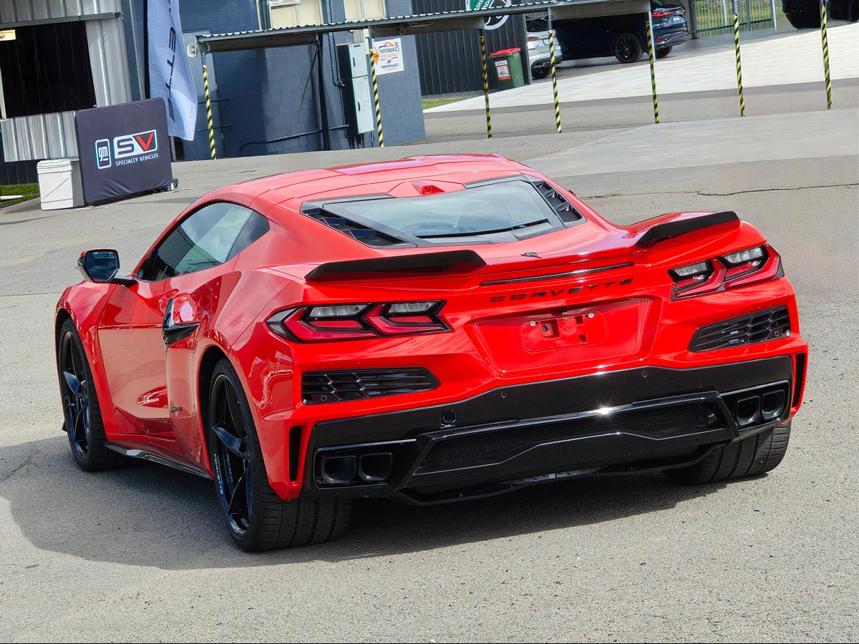
LT2 versus L87: Same family, different priorities
Both engines displace 6.2 litres, but they're engineered for very different purposes.
The LT2 produces 369kW and 637Nm in the Corvette Stingray. Mounted behind the driver and paired with an eight-speed dual-clutch transmission, it's designed to deliver responsive, linear performance in a mid-engined sports car, while in the hybrid Corvette E-Ray the LT2 is paired up with an electric motor on the front axle to pump out a total of 488kW and 806Nm.
The L87, meanwhile, produces 313kW and 624Nm in the Silverado ZR2. It shares the same basic small-block architecture, but incorporates truck-specific hardware and calibration, including Dynamic Fuel Management, which can deactivate cylinders under lighter loads.
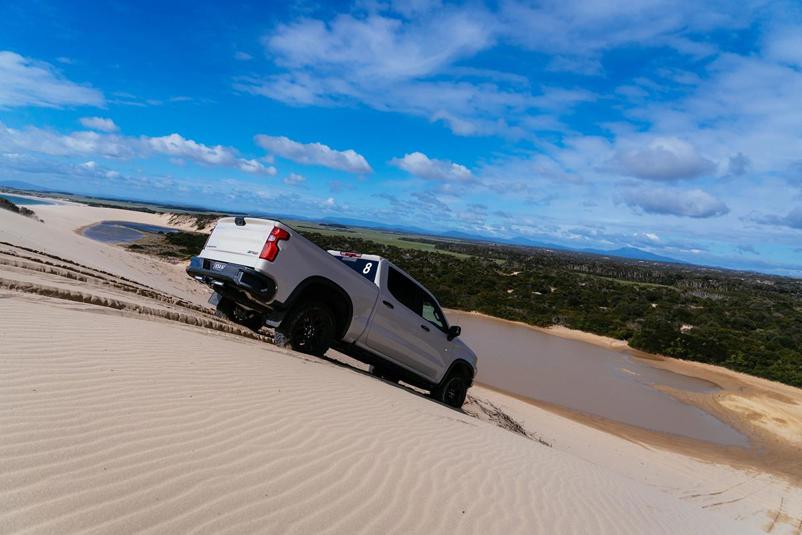
The L87 is designed to cope with towing, heavy loads and off-road work, rather than chasing lap times. In the Silverado, it's paired with a 10-speed automatic, four-wheel drive, locking differentials and specialist suspension.
In other words, GM has taken essentially the same basic recipe and adapted it for two very different environments. The Corvette prioritises performance and response, while the Silverado needs to deliver its torque smoothly and reliably across a much wider range of conditions.
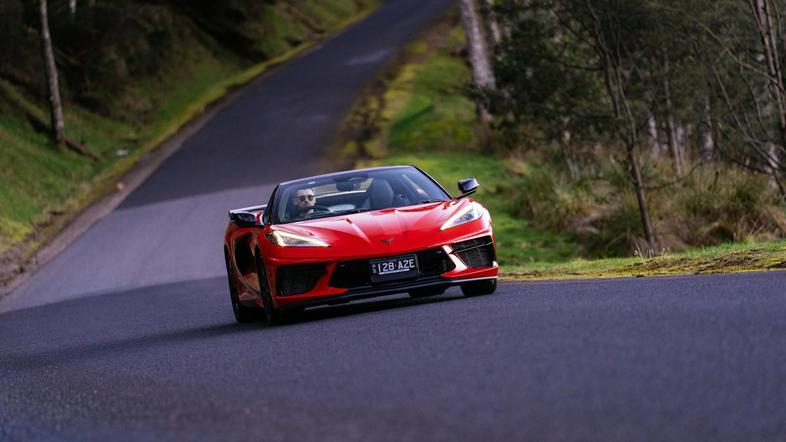
From race track to sand dunes
That's what makes driving the two back-to-back particularly interesting.
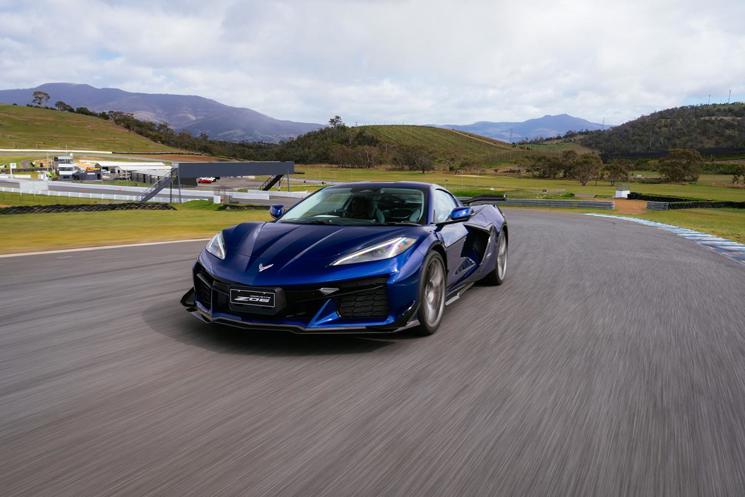
In the Corvette, the LT2's immediate throttle response, linear power delivery and mid-engined layout make it ideally suited to circuit driving. And, indeed, that again proves to be the case with simply relentless acceleration complimented by razor-sharp handling and precise, accurate and superbly communicative steering.
While the LT6 flat-plane V8 in the track-focussed Corvette Z06 is a more savage, high-revving track monster, the LT2's superb flexibility and more traditional V8 bellow is arguably as satisfying, just in a slightly different way, while the electrified E-Ray brings an added layer of sci-fi fun thanks to the scream from the electric motor under the V8's bellow.
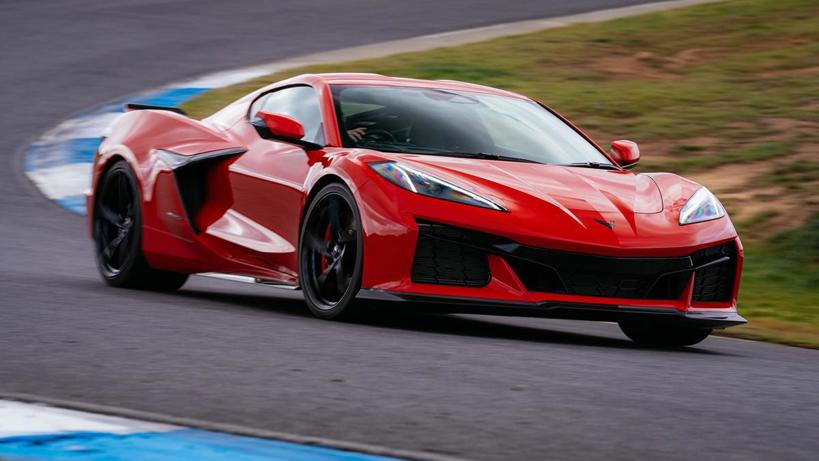
The Stingray and E-Ray also make for a far more enjoyable road experience, as they have a far more forgiving suspension tune.
The Silverado ZR2 takes that same small-block philosophy and applies it to an altogether less delicate undertaking.
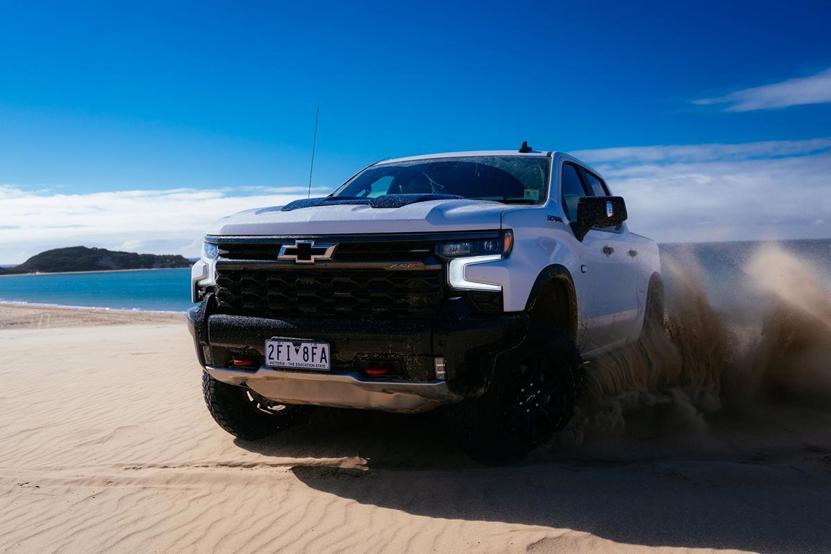
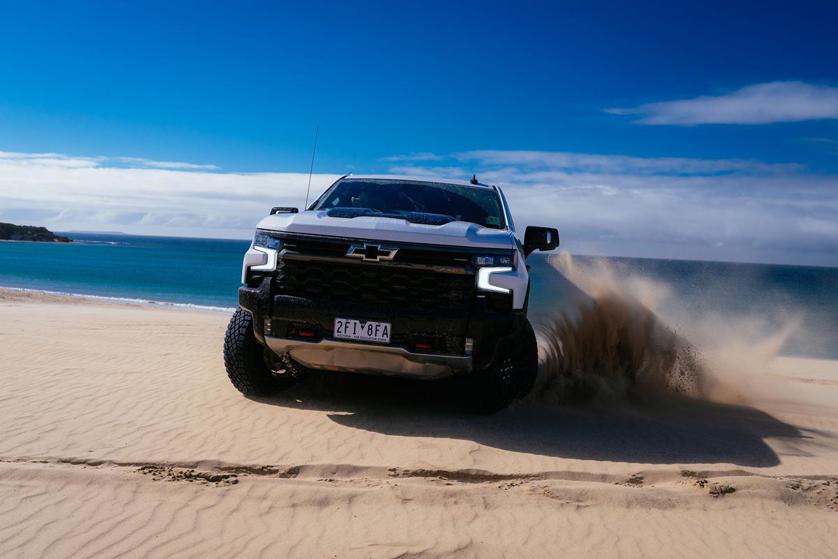
On sand, maintaining momentum and managing traction matter just as much as outright power. The L87's broad spread of torque, combined with the truck's four-wheel-drive system and specialist suspension, makes it well suited to the job - smashing over the Tasmanian sand dunes was a superbly satisfying experience in the big truck, while the big, throaty V8 bellow simply added to the experience.
Ultimately, the LT2 and L87 demonstrate why GM's small-block V8 remains relevant in an automotive world increasingly dominated by turbocharging and electrification.
For anyone who grew up with Commodore SSs and HSVs, there's something rather satisfying about seeing that familiar V8 philosophy continue in two such different vehicles. The badges have changed, and the engineering has moved on considerably, but the basic appeal remains remarkably familiar: big capacity, naturally aspirated power and a proper V8 soundtrack.


