




Sponsored by BAIC
Although new to NZ, BAIC (Beijing Automotive Industry Corporation) isn’t a startup finding its feet, this is a company that’s been building vehicles since 1958, has shifted more than 31 million units, and comfortably sits among China’s top five automotive giants. It’s also a regular on the Fortune 500, which tells you everything you need to know about scale.
BAIC’s story is one of evolution rather than reinvention. Over the decades, it’s built not just cars but credibility, thanks in no small part to partnerships with global heavyweights like Hyundai and Huawei. Its joint venture with Mercedes-Benz (Beijing-Benz) is particularly telling. You don’t get to build cars for a brand like that without learning a thing or two about quality, engineering, and attention to detail.
That influence shows. Not in a copycat way, but in the way BAIC approaches cabin design, material choice, and overall execution. There’s a quiet confidence to it, less “look at me,” more “go on, have a closer look.”
Beyond partnerships, BAIC has been busy building out its own ecosystem. Brands like BAIC (focused on on/off-road capability), Arcfox (new energy vehicles), and Stellato (a more premium, tech-forward offering developed with Huawei) give it breadth. It’s a portfolio designed not just for today, but for whatever the next decade throws at the industry.
Enter Armstrongs, a name well known across New Zealand’s dealership landscape. This partnership feels less like a gamble and more like a calculated move.
Armstrong’s wasn’t just looking to add another badge to the wall. It wanted something that made sense for New Zealand: vehicles that can handle a mix of urban commuting, open-road cruising, and the occasional off-the-beaten-track adventure. BAIC ticked those boxes, while also offering a pathway into electrification and hybrid tech.
For BAIC, the appeal is obvious, Armstrong’s brings immediate infrastructure to the table, with established dealerships in key metro areas and the ability to scale quickly. It’s a “fast start” approach, and in today’s crowded market, that matters.
Right now, BAIC’s footprint in New Zealand is growing steadily, with plans to expand to around 15 locations nationwide. But launching a new brand isn’t just about showroom space, it’s about trust.
That’s where BAIC plays a strong hand. A seven-year, unlimited-kilometre warranty isn’t just generous; it’s a ‘peace of mind’ statement. Add seven years of roadside assistance (via First Assist) and an eight-year battery warranty for hybrid models, and suddenly the “new brand” anxiety starts to fade.
The BAIC X55 arrives as the brand’s urban spearhead, sitting alongside the more off-road-focused B30. And while it leans toward city life, it doesn’t exactly shy away from flexing a bit of muscle.
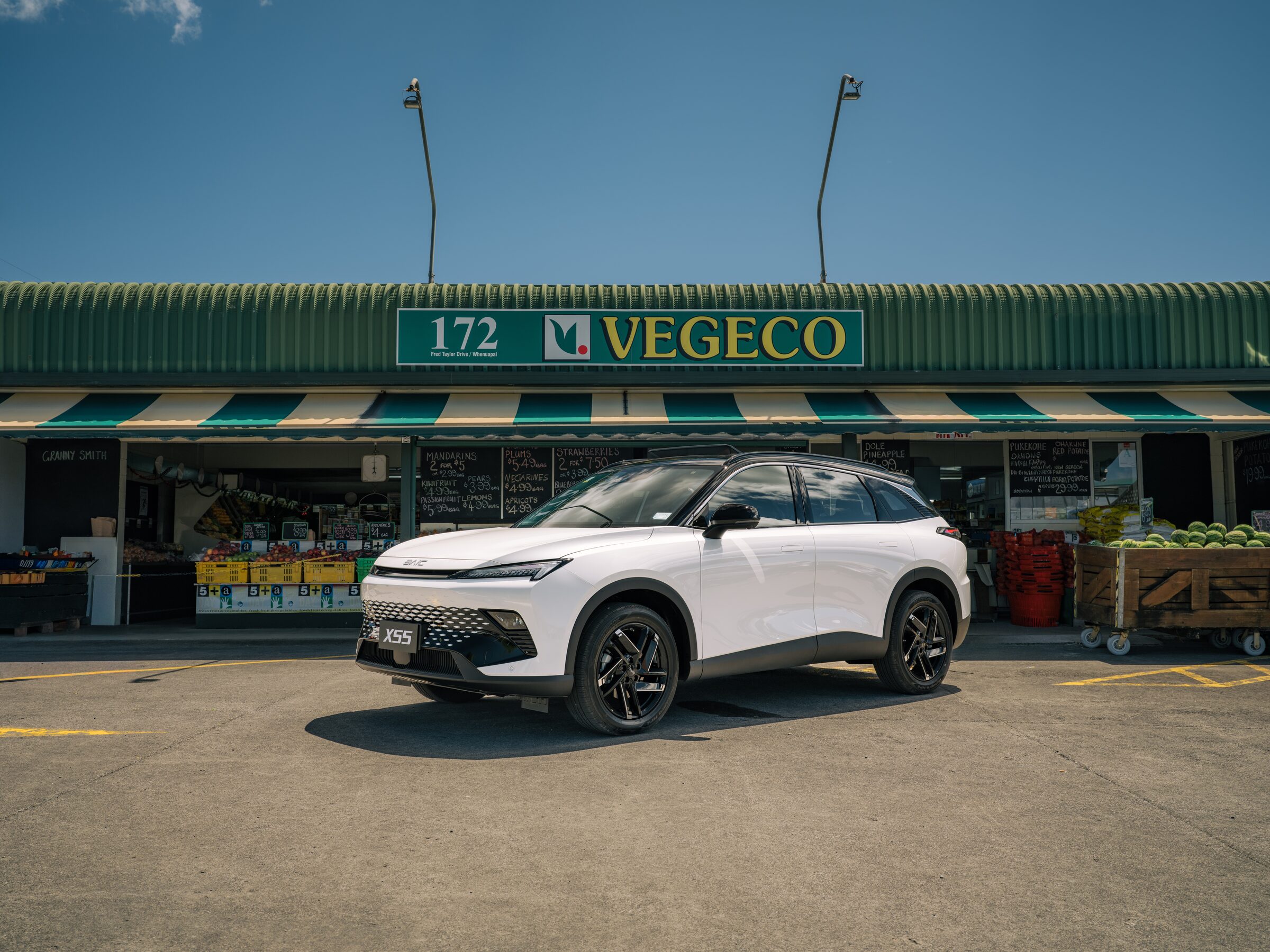
Visually, it’s a confident thing. A split rear wing, quad-tail exhaust tips, and chunky 19-inch alloys give it a sporty edge without tipping into try-hard territory. The silhouette is modern and clean, with just enough attitude to stand out in a crowded SUV car park.
But the real surprise comes when you step inside. This is where those Mercedes-Benz influences start to whisper rather than shout.
The X55’s cabin feels, let’s say, considered. Soft-touch materials, leather-style seating, and a layout that prioritises usability over gimmicks. There’s a dual-screen digital setup, ambient lighting with 64 colour options, and a panoramic glass roof that floods the space with light.
Space is generous, visibility is good, and everything falls easily to hand. It’s not trying to reinvent the interior, it’s just doing it properly.
BAIC hasn’t held back on technology, but importantly, it hasn’t overcomplicated things either. You get the expected inclusions, (Apple CarPlay and Android Auto), multiple drive modes, and a comprehensive ADAS safety suite. The infotainment system is responsive, the interface is intuitive, and the overall experience feels polished, likely helped by BAIC’s tech collaboration with Huawei. It’s modern without being overwhelming. Which, frankly, is exactly what most drivers want.
Performance is where the X55 quietly flips expectations. Under the bonnet sits a 1.5-litre turbocharged engine pushing close to 140 kW. In a segment where many rivals hover around 110–115 kW, that’s a noticeable step up.
The result is a drive that feels more eager than you’d expect. Acceleration is brisk, the transmission is smooth, and the independent rear suspension helps the X55 stay composed and planted through corners. It’s not a performance SUV, but it doesn’t feel like it’s holding anything back either. There’s a nice balance here, comfort when you want it, and just enough punch when you don’t.
On the open road, it feels refined. Not overly soft, not overly firm, just well judged for everyday New Zealand driving, whether that’s navigating city traffic or stretching its legs on the open road.
The X55 isn’t trying to be a premium SUV. And that’s exactly why it works. Instead, it positions itself as something more grounded, a high-value, well-equipped, and genuinely capable option that doesn’t demand a premium badge (or price) to justify itself.
It goes toe-to-toe with established players like Mazda, while offering a more performance-leaning character than some of its Chinese rivals like MG or Omoda. That differentiation matters, especially for buyers who want something a bit more engaging without stepping into luxury territory.
BAIC’s arrival in New Zealand is a confident one, backed by decades of manufacturing experience, global partnerships, and a clear strategy, it’s here to compete.
The X55 sums that up neatly. It’s stylish without being flashy, well-equipped without being complicated, and surprisingly punchy for its class. Add in a strong warranty package and a rapidly expanding dealer network, and you’ve got a brand that’s doing all the right things to win over sceptical buyers. And that’s before you’re wow’d by the $34,990 sticker price (no that’s not a typo).
“Made for Real” might sound like marketing speak (ok it is a bit) but in the X55’s case, it actually fits. Because sometimes, what people really want isn’t aspirational. It’s something that just works (day in, day out) and feels good while doing it.


