



- Sales of EVs in Europe surged by 30 percent in 2025.
- EVs outsold petrol vehicles for the first time, while hybrids outsold petrol and diesel combined.
- The push of Chinese carmakers into Europe is seen to be one of the biggest influences in the increase.
Europe’s transition to electric mobility reached a significant milestone in 2025, with sales of electric vehicles increasing by more than 30 percent, while sales of hybrids exceeded the total sales of traditional petrol and diesel vehicles combined.
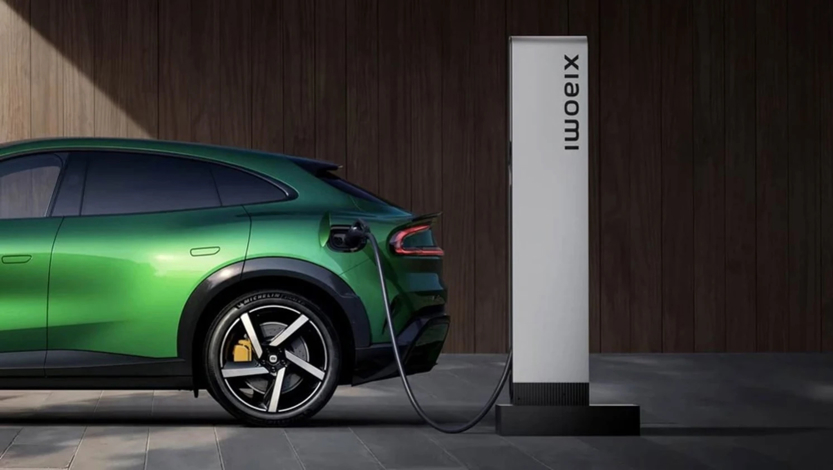
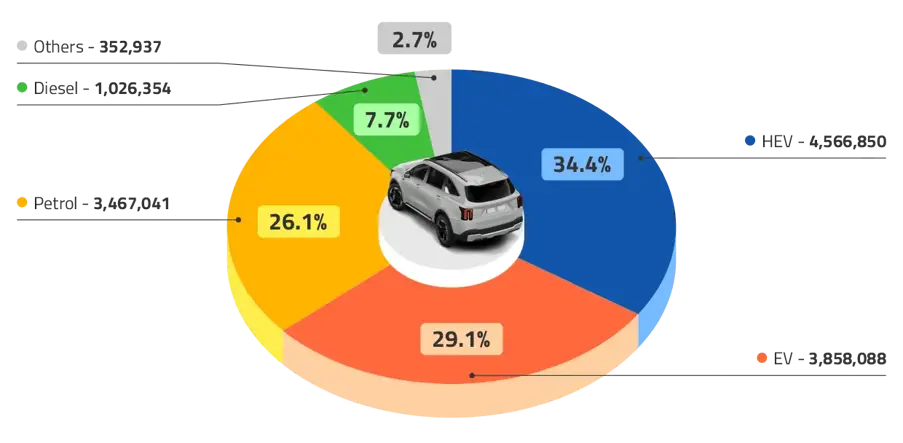
A total of 3.86 million new electric vehicles (EVs) were registered across Europe in 2025, a surge that sees electric models now account for more than a quarter of all new car registrations across Europe.
But while the shift toward greener transport is accelerating, the data reveals a complex landscape where traditional engines are fading, and hybrid technology has emerged as the most popular choice for the average driver.
According to a new report from financial analysis platform TradingPedia, Germany continues to be the largest EV market in absolute terms, with German consumers buying 856,540 electric vehicles in 2025, representing a nearly 50 percent increase from the previous year. This growth occurred despite the end of certain government subsidies, which led some buyers to hedge their bets by opting for plug-in hybrids (PHEVs) alongside fully electric models.
While Germany leads in volume, Norway remains the global benchmark for total adoption, with a staggering 97.41 percent of all its new car registrations being fully electric, effectively leaving petrol and diesel models in a sharp decline.
Despite the high profile of fully electric cars, hybrid electric vehicles (HEVs) actually claimed the largest slice of the European market in 2025. With 4.57 million units sold, hybrids captured 34.4 percent of the market, officially outpacing the combined sales of traditional petrol and diesel vehicles.
The report suggests that hybrids are serving as a "pragmatic bridge" for consumers who are not yet ready to commit to full electrification due to concerns over charging infrastructure or the higher upfront costs of battery-electric models. According to TradingPedia this is particularly evident in Southern and Eastern Europe, where nations like Italy and Spain rely heavily on hybrids as they work to improve their charging networks.
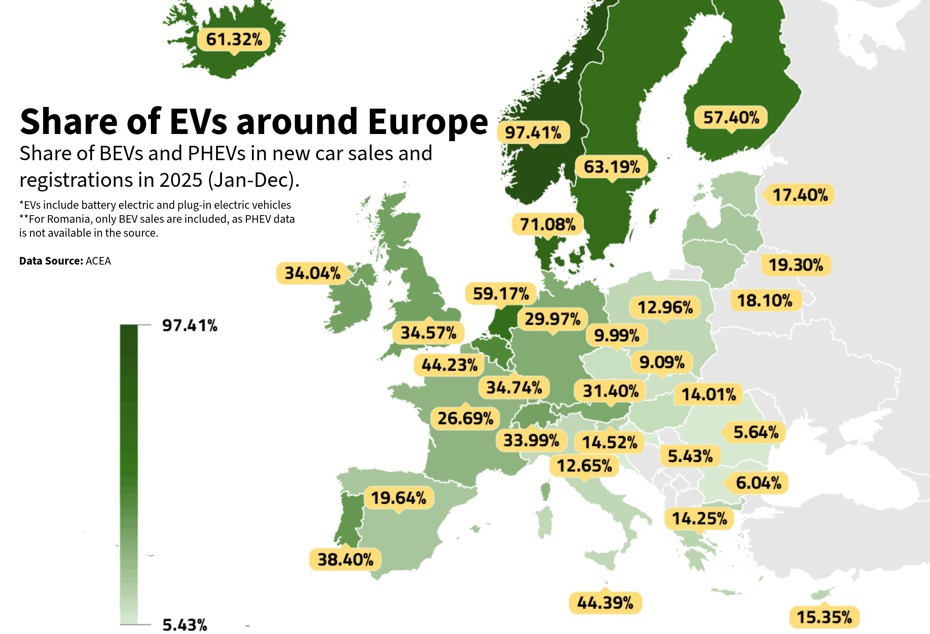
However, the pace of this shift towards EVs is remarkably uneven across Europe, and while wealthy Nordic nations like Denmark, Sweden, and Iceland see electric models outpace all other engine types, countries such as Bulgaria, Croatia, and Romania remain largely dependent on internal combustion engines, with EVs making up less than 10 percent of their new car sales.
Despite this, the most explosive growth is currently occurring in Central and Eastern Europe; Poland, Lithuania, and Latvia all saw their EV registrations more than double in 2025, with Poland in particular standing out as a potential turning point for the region, with its electric vehicle share rising to 13 percent, more than twice its previous level.
In terms of what people are actually driving, the competition between manufacturers has intensified with the emergence of Chinese manufacturers entering European markets. Despite this though, the Tesla Model Y maintained its position as Europe’s top-selling electric vehicle in 2025, even as the brand faced increased pressure from European and Chinese rivals.
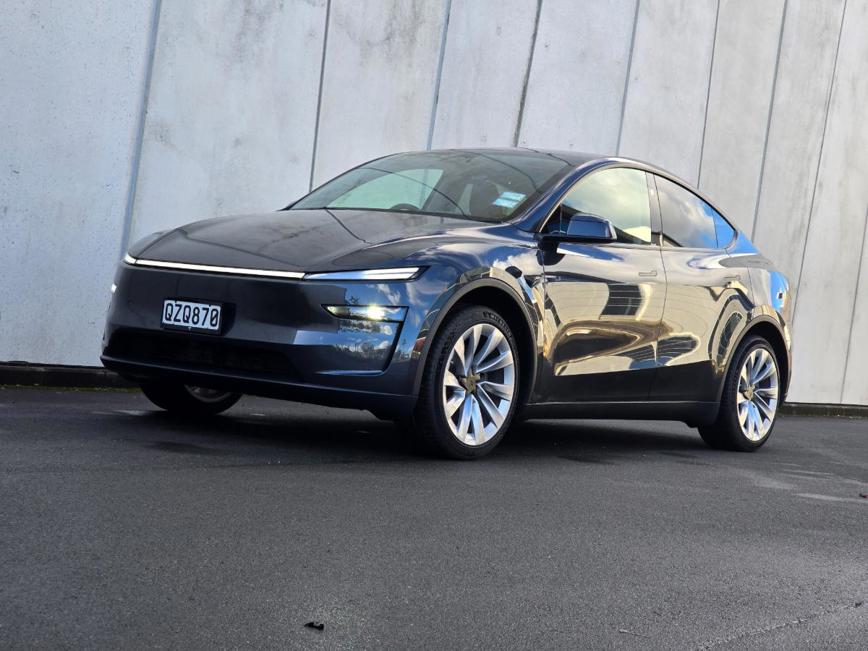
Tesla has been on the decline in Europe for over a year, a trend driven in large part by the intense competition coming from Chinese manufacturers, but also increased effort from European carmakers. While the Model Y remained a top seller in 2025, the increased variety and competitive nature of Chinese offerings are eroding its dominance significantly.
The Volkswagen Group has maintained a strong foothold with four vehicles - the Skoda Elroq, VW ID.4, VW ID.3, and Skoda Enyaq - in the top ten best-sellers, while Chinese manufacturers like BYD are making significant inroads, particularly in the plug-in hybrid segment, highlighting the growing transformative influence on the global car market China has exercised by reshaping consumer demand through aggressive pricing and dominating key technology segments.
In Germany, Europe’s largest auto market, aggressive pricing from Chinese automakers has fundamentally reshaped consumer demand there, contributing to the sharp rise in the popularity of PHEVs there, an area where Chinese influence is particularly visible.
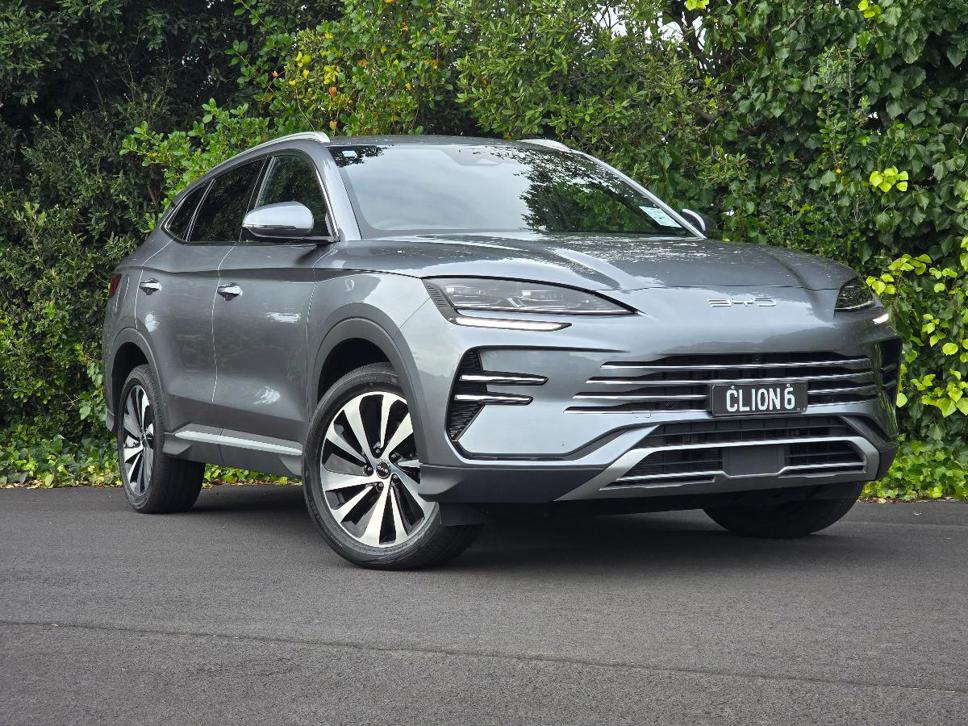
The BYD Seal U (which is called the Song Plus in China, and the Sealion 6 in New Zealand) has emerged as the leader in PHEV sales across Europe, with 63,233 units registered, highlighting the growing pressure Chinese firms are placing on traditional European rivals as they capitalise on consumer preferences for flexibility and lower upfront costs.
Meanwhile, the wider battery-electric vehicle (BEV) segment in Europe is currently seeing a shift toward more compact and affordable models, where Chinese manufacturers are at the forefront, effectively forcing the entire industry to prioritise price and efficiency to remain competitive against imported models.
The full report by TradingPedia can be downloaded here.


