



Thursday Five: The biggest moments in Melbourne's Australian GP history
The Formula 1 championship returns to the airwaves this weekend for the 2016 Melbourne Grand Prix, and there’s plenty to talk about — Bernie’s continual criticisms, the new halo concepts, a revised qualifying system, and whether anyone can stop Mercedes-Benz from another season of dominance all included.
The Australian GP at Albert Park has always been a fan favourite, largely due to a relatively tranquil venue and an interesting circuit layout that lends itself to high-quality racing. It’s a classic opening venue, where the scenery and relaxed happy-go-lucky vibe can distract all and sundry from the nasty words they all said about each other in the off season.
So with another potentially historic event scheduled for this Sunday, let’s take a walk through victory lane to examine some of the most memorable moments of Melbourne Grand Prix history for today's Thursday Five.
The 2002 Grand Prix
Recently nominated by fans as their favourite ever Melbourne GP, the 2002 event was a race book-ended by pivotal plot points.
Lap one saw a stunning crash take place between Ralf Schumacher and Ruebens Barrichello, the former vaulting spectacularly over the latter like a ramp, sailing through the air before crashing back to the earth on the outside of turn one. A further six cars would also be taken out in the crash, as the field attempted to avoid the Barrichello’s pirouetting Ferrari.
While Ralf’s little bro Michael had the race sewed up a bit over an hour later, eyes from all over Australia were focused on the battle for fifth as a debuting Aussie upstart named Mark Webber attempted to hold off a hard-charging Mika Salo. Webber’s sluggish Minardi was no match for Salo’s Toyota — a comparison made only clearer when the Minardi lost its top gear.
But after several laps of beating on the back of Webber, Salo suffered a slow spin at turn four, handing Webber the position while thousands of trackside punters erupted in cheers in a nail-biting finish that will go down as one of Webber's finest moments.
Hamilton’s debut
While I'm far from the world's biggest Hamilton fan, I feel that the Brit is one of the key components of Formula 1's contemporary landscape. Next to his rivals, he sticks out like a sore thumb as one of the sport's rock stars — for better and for worse. Face it, how much additional press coverage and hype does Formula 1 get directly because of Hamilton's behavior?
But he wasn't always like this. When he made his debut in the 2007 championship, he was a humble, softly spoken gent, who was exceptionally likable. Scoring the plum drive with McLaren, some questioned the decision to place a relative unknown in the car. Little did they know that Hamilton had been under the eyes of McLaren for several years, with their faith in the driver justified almost immediately as Hamilton finished third in his debut drive.
A star was born into the sport that day, and by the end of 2008 he would be world champion.
Button and Brawn win
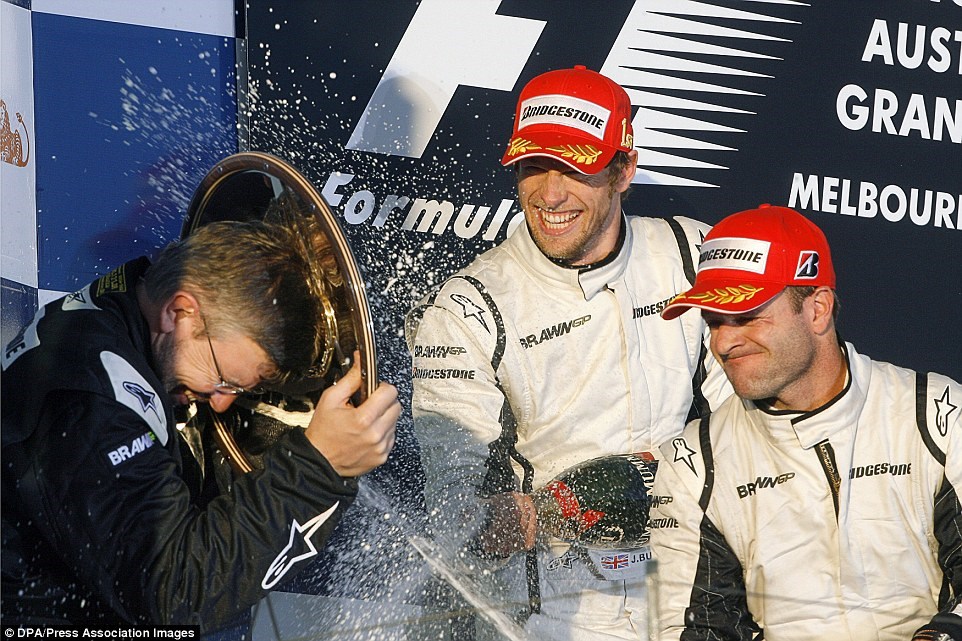
Button and Barrichello spray team boss Ross Brawn while on the Melbourne podium. Photo / DPA
In contrast to Hamilton's fairy-tale 2007 debut, the win shared by Brawn GP and Jenson Button was a strange one — one that saw the tides shift in the sport. Spawning from the ashes of Honda, Brawn's success out of the box (teammate Barrichello finished second, making it a 1-2) was a sign of the times, and emphasized how much teams had to gain in future by investing as much as they could, as early as they could, into car development.
The squad went on to win six out of the first seven races of the series, with Button sealing the championship title by the penultimate round in Brazil, while his teammate finished in third.
Youth challenges experience
While Hamilton can in some respects lay claim to the 'rockstar of F1' label, he certainly would find a rival for the crown in Canadian Jacques Villeneuve — something made plain during Villeneuve's debut with Williams in 1996, where he took on his more fancied teammate Damon Hill, and nearly won.
Coming off a year where he had won the Indy 500 and the IndyCar championship, Villeneuve was positioned in a competitive Williams. And the signing looked to be a good one, as the driver planted himself on pole position for his debut. After initially losing the lead to his teammate, Villeneuve wrestled it back during the pit cycle after an aggressive move through turns three and four saw him round up his far more experienced teammate with a sublime outside-line pass.
After looking like a certain winner, Villeneuve lost the win in the dying laps thanks to an oil leak. He similarly lost out on the championship too after a year-long battle with Hill. But, he'd get his turn the following year, simultaneously establishing himself as one of the most outspoken drivers in the sport.
Brundle’s recovery
“This is well-nigh unbelievable,” rang the voice of Murray Walker, as a shaken-not-stirred Martin Brundle discussed his crash with officials, as they all looked over his destroyed Jordan Peugeot.
In a crash strangely similar to that of Barichello and Schumacher's, Brundle had ramped off another car and into the air in the braking area to turn three. Though this time, Brundle had landed on his lid, sliding at speed into the sand trap.
In isolation, this was a nasty shunt. But in the context of 1996, this crash was huge — the first major spill after Ayrton Senna's fatal Imola crash of 1994.
Walker's panicked and relieved voice wasn't just commentators instinct, it was worry felt by everyone in pit lane that this could be another major incident for the sport. Luckily, Brundle was able to get out of the car, brush himself off, and get the OK from Professor Sid Watkins to continue on in the team's back-up car — all in a matter of minutes — before rejoining the grid for a full-race restart. And in doing so setting the tone on safety in the sport for years to come.