



- New ANCAP safety rating criteria have been revealed.
- The safety body has based its criteria on what it calls the "Stages of Safety".
- It has also renewed its call for wider support of automated emergency calling in New Zealand.
The Australasian New Car Assessment Program (ANCAP) has unveiled a major refreshment of its vehicle safety rating criteria, scheduled to take effect from 2026, while also renewing its call for automatic emergency call (eCall) systems to be more widely implemented in the New Zealand market.
The new safety criteria have been developed in collaboration with leading experts from Euro NCAP and provide a shared international benchmark for vehicle safety testing.
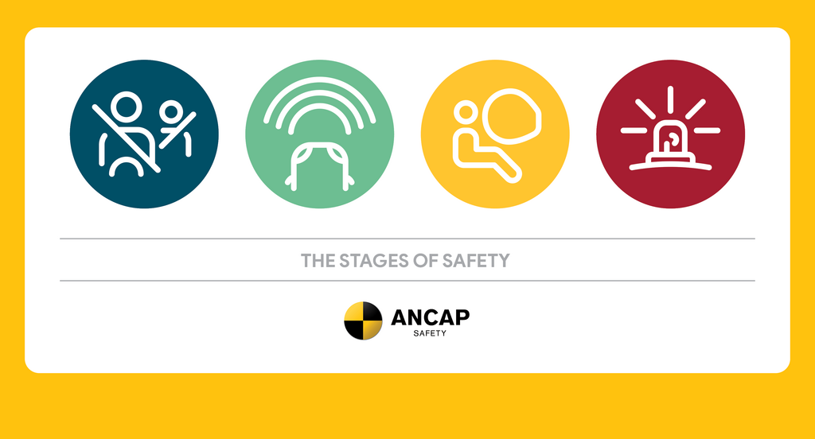
The core change is a reorganisation of the assessment criteria into what ANCAP calls the "Stages of Safety", which are based on the Haddon Injury Prevention Matrix that examines what happens before, during, and after a crash.
"You’ve spoken and we have listened. The Stages of Safety approach will allow ANCAP to incorporate useful feedback, enhance existing tests and incorporate new areas of focus," said ANCAP Chief Executive, Carla Hoorweg.
"This new approach also provides a structure that can adapt to the technological developments that will shape the automated driving future."
The four assessment areas that make up the Stages of Safety and will be evaluated from 2026 are:
- Safe Driving - which considers technologies that assist in providing a safer driving experience.
- Crash Avoidance - which assesses systems that help prevent or mitigate critical incidents through warnings or autonomous intervention.
- Crash Protection - which evaluates traditional safety elements like vehicle structure and airbags to mitigate injuries to occupants and vulnerable road users.
- Post Crash - which addresses the critical ‘golden hour’ of emergency response through rescue information and assistance systems.

ANCAP says that, while all four stages are crucial, the traditional elements of cabin structure, airbags, and seat belts - the Crash Protection stage - will continue to carry the most significance. Each of the four stages will be scored out of 100 points and expressed as a percentage, with minimum thresholds applying to determine the overall star rating.
According to the organisation the 2026 protocols will "strengthen the rigour and relevance" of tests, rewarding vehicles that perform well across all stages, while in response to consumer feedback, active driver assistance systems that are often criticised for abrupt or irritating interventions will now be rewarded for smooth and intuitive operation in addition to their technical performance.
The new protocols will also encourage "smart coupling" of driver monitoring and crash avoidance systems, where the sensitivity of crash avoidance features (like Forward Collision Warning and Lane Support Systems) is enhanced or minimised based on how engaged the driver is, a concept ANCAP calls the Driver State Link.
To combat distraction, manufacturers will also now be encouraged to provide physical buttons for primary driving controls - such as the horn, indicators, wipers, and headlights - or dedicate a fixed portion of the cabin display screen to these functions, while vehicles will also score points for smart systems that monitor pedal inputs alongside crash avoidance cameras and sensors to recognise potential dangers and automatically reduce acceleration if the driver unintentionally presses the accelerator instead of the brake.
The Post Crash assessment acknowledges the critical role post-crash response plays in crash survival in the immediate aftermath of an accident (the so-called 'Golden Hour') and ANCAP will now place greater emphasis on the availability and performance of eCall systems, which automatically connect with emergency services and provide first responders with detailed information, including GPS coordinates, crash severity, and occupant details such as how many occupants were in the vehicle and whether they were wearing seat belts.
ANCAP was critical of New Zealand deployment of eCall technology, which remains limited here, with fewer than 10 percent of new vehicles sold last year equipped with the system.
“Our updated protocols set a clear benchmark for emergency call systems fitted in vehicles. We want to encourage manufacturers to enhance existing systems and provide an incentive for all brands to fit this life-saving technology,” said Hoorweg.
"New Zealanders should not be left behind when it comes to life-saving technologies such as eCall, the potential for it to make a difference on New Zealand’s road is too big for manufacturers to ignore."